


by Liz Ross
Liz Ross: Your debut novel The Daughters of Rosebud was released this month. Can you tell us a bit about your inspiration for the story?
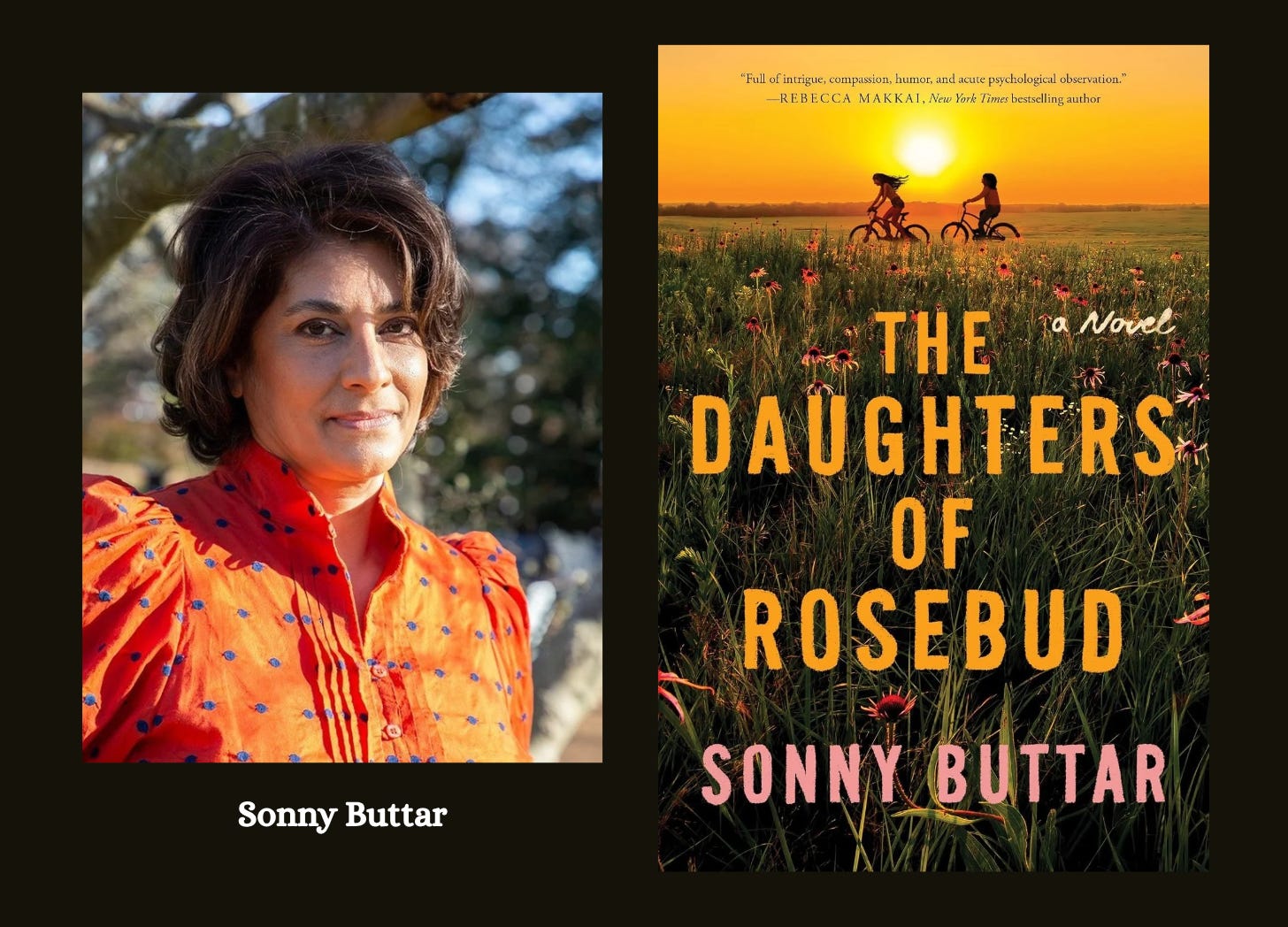
Sonny Buttar: I recently came across an old notebook from 2002 or 2003. I was taking an evening writing class back then and this notebook was filled with handwritten notes about Asma and Salma. They didn’t have names then. I hadn’t imagined them as sisters yet. They were just these character sketches I had no memory of writing. So these characters existed in my head for a long time before I started doing anything with them. Then in 2015, when I began working on the novel, I read a story in The New York Times about a horrific act of violence. That was the first moment I had an idea what the story could be about. That was the initial inspiration. It got me thinking about one of the worst things a person can experience.
LR: Not to give too much of the story away, but the novel revolves around a devastating act of violence. Would you speak about what it is?
SB: It’s a crime of passion, an impulsive act that has consequences further reaching than the person committing the act can imagine.
LR: Your novel has a dual timeline—1989, the year of the events in question, and 2007, the aftermath. In 2007, Salma is working as an elementary school teacher. I was interested in your decision to have her working with children.
SB: Salma had a complicated coming-of-age. I think someone who experiences that kind of trauma has to stay simple. She needs to be where the love is pure, where feelings of attachment are going to be reciprocated. So it’s basically animals or children. I wanted Salma to have something that gave her solace.
LR: I was drawn to Salma’s uncle, Mamoo. I admired his ability to love so wholeheartedly after enduring crushing losses. Could you speak to this capacity?
SB: Grief is this incredibly complex thing. There are some people who are able, without diminishing their loss, or the amount they loved someone, they are able to let the grief flow through them, experience it and feel it, and then let it move through them. And there are others in whom it gets stuck. They are unable to face the loss or the pain and there can be lasting consequences.
LR: Do you think you could have written this novel at age thirty? How might it have been different if you had?
SB: Like, could I have written this same story in this same way at a different point in my life? Yes, I think so. This story does not emanate from a life experience that I didn’t yet have at thirty. It’s entirely imagined and outside of me.
LR: At Bloom we’re always interested in a person’s path toward publication. Could you tell us a bit about yours?
SB: I started working on my MFA at age 50. And, you know, if you listen to conventional wisdom, the odds are not with us to get published in general. As we get older, the odds are even lower. So I didn’t assume it would happen for me, but I’m really stubborn. I think you have to know what you’re in it for. For me, pursuing my MFA was about learning to become the best writer I could be. And then my goal was to write the best story I could write. Beyond that, there was just a private fire burning inside me to get this story out there.

Sonny Buttar was born in Pakistan and raised in England and the American Midwest. Her first novel, The Daughters of Rosebud, is out now from Lake Union Publishing.
Liz Ross is a graduate of the MFA Program for Writers at Warren Wilson College and has several publications in LEON Literary Review. She was the 2025 Marilyn Harris Teaching Scholar at Longleaf Writers Conference, and has been a contributor at both the Bread Loaf Writers’ Conference and Sewanee. She lives in Southern California with her family and works in a school library. Regal House Publishing is releasing BELIEVER, her first novel, in 2028.