

DISPATCH FROM EVERY SECOND GUESS: Q&A with Megan Gannon
A Verse-Memoir at the Intersection of Pretty Poems and Ugly Truths

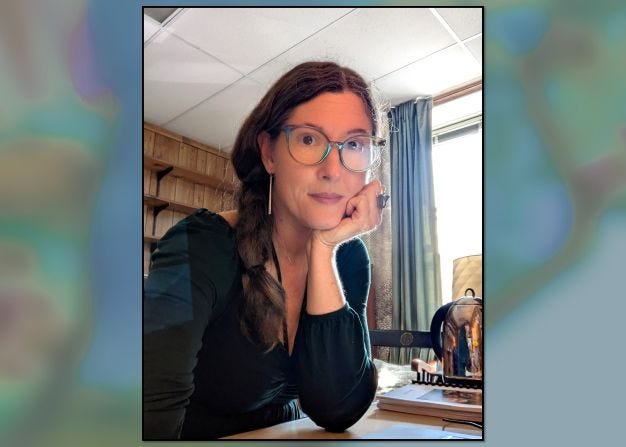
Poet and novelist Megan Gannon’s new verse-memoir Dispatch from Every Second Guess (Dzanc Books) is as intimate as any poem and as candid as a memoir ought to be. We recently sat down to discuss Gannon’s honest self-reflections, the role of poetry today, and her experience writing in a hybrid form.
… but how can I name

the spring leaves without also mentioning the brown tatters
of seed strings, too damp and tangled to flutter or fall, clumped

like a scum on the wind-riffled limbs? …

“Dispatch from the Ars Poetica” Dispatch from Every Second Guess

Shabana Kayum: How did a verse memoir come to be? Did you set out to write a memoir?
Megan Gannon: I was very frantic to get my first books published because I was going through a divorce, and in my mind, I needed to get a tenure-track job to support myself and my child. After many “always a bridesmaid, never a bride” encounters with agents and contests, I found a small press that published my first novel, and they went ahead and published my first book of poems as well, which I was very grateful for.
And because I had this big life shift, single parenting in a state where I knew no one and had a new, very intense job working towards tenure, I was writing when I could—little poems here and there to help me process. I met my partner about three years after I moved and had a surprise pregnancy, which brought a whole bunch of new life shifts, and then came the pandemic. I was writing poems to help me get through it—a little bit of venting. I know that’s usually considered a no-no with creative writing. We’re supposed to be thinking of our readers more and be more generous, but I found there were things that were really ugly that I needed to say. I had maybe twenty poems before I realized these were all dispatches of a sort. And they all work best as long couplets.
SK: I wanted to ask about your couplets and why you chose that particular form.
MG: It was actually a conversation with a writer friend, Amy Ratto Parks, who first suggested a big stylistic shift from my earlier poems. I’d written these very sparse small-lined lyrical poems before she said, “I think for what you’re writing, you’re gonna need longer lines.”
The impulse behind this book is something I’m still processing, but as I was writing what in my mind were ugly poems, I looked around for others who had also written ugly poems, and I didn’t find many. I didn’t want these poems to just be for me. I wanted them to be for anyone going through hard things and having to say ugly things or acknowledge awful things they’ve done and try to forgive themselves. I chose couplets because I’m trying to connect with someone. There is a suggestion that the line is reaching someone else, and we’re in this together.
SK: I think of the idea of a verse-memoir in the same way. In poetry, you invite your reader to experience what you’re experiencing, whereas in prose, you’re recounting your own story. That’s actually quite lovely. Can you talk a little more about how these poems differ from your general style of poetry?
MG: One reason why I write both prose and poetry is because I get restless and want to try new things. I reached a dead end with that sparse lyrical style that I used to write in. I think it was a deflection mechanism. When I look back at a lot of the poems in my first book, they’re trying to acknowledge unhappiness and say ugly things, but they’re doing it in a wispy, pretty, graceful way. I didn’t want this book to be graceful and pretty. I wanted it to be hard truths. It started to feel like a feminist project in some ways because when I saw the dearth of books written by women about their own ugliness, it felt like I needed to fill that hole. We have no problem finding books written by men where they talk about their alcoholism and their womanizing and their terrible behavior, and this gets idolized by other young male writers. I’m not hoping that women will idolize my behavior in this book, but I definitely hope that if they’ve had similar experiences, it’ll give them a place to see it, process it and work toward reconciliation with whomever they’ve hurt and find forgiveness with themselves.
SK: I think representation really matters here. If you can see your own “ugliness” in others, maybe you can understand that it’s not something detestable in yourself. It’s human. That’s actually a really great reason to write. Do you imagine your overall style of poetry will change after this collection?
MG: I do. I don’t like to keep doing the same things. It always takes me a while, so I’ve written a few poems that feel like they are still hanging on to this book. Then I go into a sort of hibernation period, where I let whatever needs to be in a chrysalis turn into goo and reshape itself. So, I don’t really know what those next poems will be until I start writing something that feels different.

SK: In terms of going back to lyrical poetry or “pretty” poetry, you’re not intending to do that with your poetry anymore?
MG: I still really value sound and density of sound. One of the things that first attracted me to poetry was the sense that sometimes you could follow sound and it would lead you to discoveries that were interesting and surprising to yourself. That still remains one of my favorite experiences in writing poems. I can’t shut down my ear, so there are still moments in this book where you can hear the poem listening to itself, where I’m picking certain words because of how they echo. I’d like to move towards something a little more dreamlike. I’m interested in the Gothic genre. (Although it hits a little different right now with the Epstein file reveals.) I like the way that Gothic reveals while also keeping things undercover. That’s where I want the poetry to go, where things don’t need to be said quite so plainly.
SK: When I open up a collection of poetry, I rarely start at the beginning. I’ll open its pages somewhere in the middle and start reading. How do you hope readers will engage with this collection?
MG: That’s usually how I read books of poems, too, so it’s funny that I wrote this book that has this little plot arc. I think that you can still read the book any way you like. It will hopefully invite multiple readings, as all poetry maybe does. You can dip in and read here and there. Each poem feels like its own little chapter, or episode, or scene in some ways. And then if you do want to go back and read it cover to cover, you get that plot arc, but also you start to see how certain images recur and resonate and change. It can be read in any number of ways, and hopefully it will continue to reward multiple readings.
SK: With this book, you’re in a unique space. This is the first verse-memoir I’ve read. What advice would you give writers interested in hybrid forms?
MG: I was a little worried about calling this a verse-memoir. We’re kind of in the post-confessional age. Most of us tend to write from our experience. We write poems that are based on our lives. But this collection was more about the nitty-gritty of relationships and daily life. It felt a little different from other poetry collections I’d read. I was very scared to give myself permission to call it a memoir. I had some imposter syndrome and thought, well, maybe it’s just a book of poems.
I would say, give yourself permission to call it whatever you want, and you can call it something else later. I often teach Jennifer Egan’s wonderful, Pulitzer Prize-winning book A Visit from the Goon Squad, and we crack up because it’s a book that reads as individual short stories with recurring characters. Each story reads well in isolation, but on the cover it says “a novel.” We always laugh about that because short stories don’t sell very well, but novels do. Egan and her editor made a very wise decision. So, give yourself permission to be savvy and make whatever calls you need to make.
SK: Do you have any advice for poets in general?
MG: We’re at an interesting moment in publishing because people can self-publish and find pretty big audiences from it. That’s a question that comes up in my creative writing classes. You can write whatever you want by yourself, but you took a class for a reason, right? So, what is it that you’re hoping to get out of the class and apply to your writing? One of the conversations I like to have with students is about the literary canon as a set of semi-arbitrary rules. Some of my favorite books are experimental and don’t do the things that books are supposed to do. They don’t play by literary marketplace rules.
We’re also at this weird moment with ChatGPT. Some students take my creative writing class and then turn in robot-generated stories and poems, and it’s really upsetting because two-thirds of the class are there because they’re excited to write. I have a hard time believing that [AI generated stories] resonate in the same way that things written by humans resonate. They don’t have lives to draw from. This book could not have been written by ChatGPT. And I’m always going to go to books that were written by people who are going to fearlessly write about their own lives and fearlessly do things that the literary marketplace doesn’t necessarily want. My advice is just lean into your own bravery, lean into your own passions and write what you want to write. Or to paraphrase the famous Toni Morrison quote, write the book you want to read.
SK: In “Dispatch from the Ars Poetica,” you begin “I would like to be more generous to you.” And later, you say, “I need to write the things I don’t want to say.” Throughout the collection there is a sense that the poet is neither writing what she wants to say nor what her audience might want to hear. Can you describe this battle of expectations?
MG: The poems I’d read from women poets writing about their lives were beautiful, picturesque poems—“here I am in my garden eating raspberries and cream, and I am very graceful and compassionate, and I always say the right thing, and I always process things in the most kind, beautiful way.” And that was not me at all, so I felt like, “Hey reader, I’m so sorry. I can’t give you that beauty and that grace.” I love reading those books of poems, too. They’re feel-good reads. This collection isn’t necessarily a feel-good read, but I think it’s a feel-important read, at least for me.
It was a struggle to just plainly talk about some of the ugliness in my life. I ended up cutting one poem from the book that Chelsea Gibbons, my editor, felt should stay, but it was a poem about my ex-husband and how my marriage came to an end. And it felt like one of the bitchier poems in the book. Ultimately, I thought someday my 16-year-old son might read this book, and I don’t necessarily want him knowing some of those things. I cut it, and I don’t regret that decision. But that poem was important for me to write because I needed to get all of those things down on paper. It gave me permission to write some of the other poems in the book. My partner pointed out to me that I didn’t cut the one about his ex-wife, and I said, “Nope!” So, sorry to my partner. He’s actually an accepting and supportive person. He did read this book and had input on some of the poems, particularly the ones that his daughter was in. He gave me permission to say whatever I needed to say.
SK: We’ve touched on the idea that these are crazy times that we’re living in right now, with the Epstein files and the rise of fascism. In “Dispatch from Another Familiar Fairy Tale,” you say, “loyalty and bravery and cunning and all those fairytale virtues,” they save “no one in this age of senseless storylines.” I’d like to connect that to your description in “Dispatch from the Manuscript’s Every Second Guess,” where you write “no one will call this book beautiful.” In these times, with these senseless storylines, what do you think the function or purpose of poetry is in today’s world?
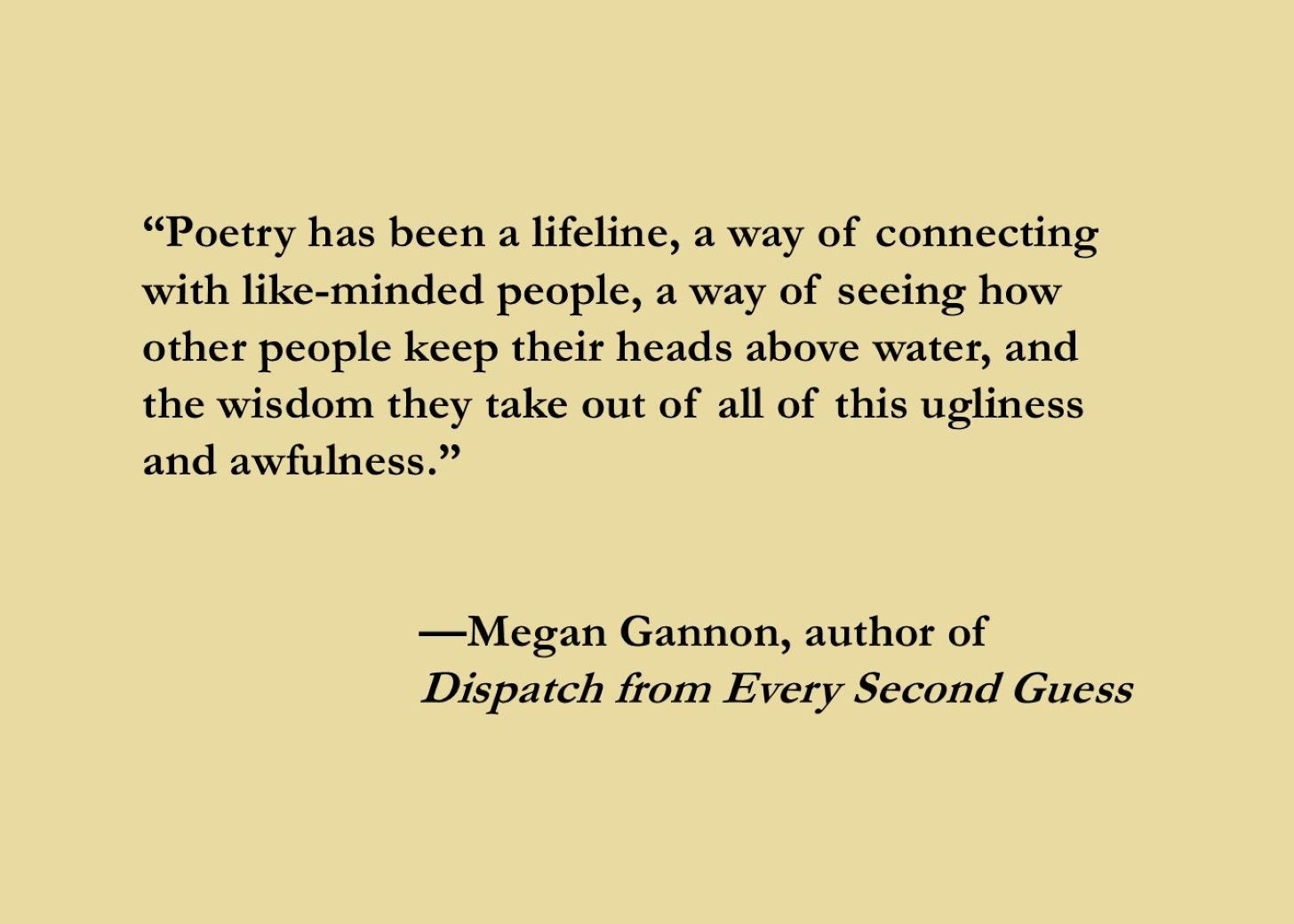
MG: Poetry has been a lifeline, a way of connecting with like-minded people, a way of seeing how other people keep their heads above water, and the wisdom they take out of all of this ugliness and awfulness.
You know, it’s funny. When you read that line to me in isolation, I thought, oh, that’s not really true at all, is it? But in the poem, it’s true because it was about my anxiety as a mom. Anytime I was letting my kids out in public, in a crowded space by themselves, I worried that there would be a mass shooting and I wouldn’t be there to protect them. I explicitly told these two kiddos when we let them go shopping for Christmas presents at the mall, if something happens, both of you just run for the nearest exit. Just get out. I told them don’t try to look for each other, just both of you get to the exit, because there might be times when it’s every man for himself.
But obviously, I think the way we’re going to survive this moment in history is not at all every man for himself. The only way we’re going to survive is by connecting and organizing. One thing I keep saying to myself right now, because it’s so hard to remember, is that imperfect allies are not enemies. We should all lean into finding common ground. And particularly as a cis-het white woman, I think I can do that work. I’m only one step below in the power structure from cis-het white men, so I have a lot of power, and we’re seeing that a lot of white women are using their power for good. I can definitely lean into building allyship with others and not expect people who are members of groups that are being targeted and terrorized to do that bridge-building work because they’re just trying to survive.
SK: You did acknowledge your privilege in the book, which I found refreshing. I also noticed what seemed to be a hesitation to talk about your son, who is Black, or feature him in the way you featured your partner’s ex-wife or his daughter.
MG: He shows up quite a bit in the book. I noticed I didn’t have many poems written directly towards him while other poems in the book are dispatches to particular people. I was upset when I noticed it, but the reason I don’t have any poems written to him is because I know his personality, and I know that poems aren’t the way to talk to him. I’ve read him all the poems that feature him, and his response is always, “Bruh, I don’t even know what that means.” He and I went through a rough stage during the pandemic, but there’s just no beef there. Honestly, that’s probably one of the reasons I don’t address a lot of poems to him—I don’t really need to work out anything with him. We have a solid bond that we’ve always had since he was little. Whereas a lot of the other people that I address in the book, I’m trying to work out something with them or about them.
There is also a hesitancy to talk about his experience because it’s an interesting position that he’s in. He has white adoptive parents, and he’s been raised pretty culturally white. He and I have definitely identified some moments in his life where he encountered racism—I mention the pool at Disney World in “Dispatch from a Hotel Pool.” I’ve felt like my whiteness was this umbrella of protection around him. I would recognize in other white people what I saw as a racist impulse toward my son, and then when I’d show up, they’d shift. I’m ambivalent about how to use that white privilege. In that moment in the pool, when I recognized that the decision [to not engage] put him in danger, I made a conscious choice moving forward. It feels like a betrayal to the Black community, but for the sake of my son, I will use my white privilege to protect him—and to make racists be less racist to him. I didn’t get to the bottom of all of that in the book, but I started to. And it’s an ongoing conversation for adoptive parents of children of color. And I think that’s completely fine. A memoir doesn’t have to get to the bottom of everything, right?
SK: The book has a few separate dispatches from a familiar fairy tale. What is your writing relationship with fairy tales?
MG: I have an abiding interest in fairy tales. I teach a class in fairy tales, and I’m drawn to oral stories in general. I also teach some West African epics. I love the idea that stories can be communal—that every storyteller can make their own tweaks, but there’s still this resonant core that lasts. But because they’re such cultural texts—so instantly recognizable—when you identify something as a fairy tale, people bring the whole emotional and narrative palette with them. There’s already depth there that I don’t have to build from scratch. And for this book, using that fairy tale scrim a number of times allowed me to talk about things that felt especially difficult or invasive to name directly, especially when it wasn’t just my story. It became a faux-fictionalizing of my memoir, which was helpful.
SK: I love fairytale retellings. You can get a lot out of them, and they easily lend themselves to relationships between women, be it mother/daughter or rivals. One “Dispatch,” seemed a retelling of Snow White, and you placed yourself as the queen.
MG: My partner’s daughter figures pretty prominently in the book, and I realized a lot about myself through how I was or wasn’t showing up for her. It was really important to me that she read the manuscript before it went to press and had some veto power. I thought she’d hate it—be angry at me. Sure, there are a couple of lines where I call her out—“Hey kid, you’re kind of being a brat”—but mostly, I tried to say, “Hey kid, you got a raw deal. People aren’t showing up for you. And I get you because we’ve got similar moms.” I think maybe she felt seen.
In that poem, I recognized, “Oh, I’m the evil stepmother here.” It’s hard to know what’s the right thing to do when you’re trying to parent a child through a really hard time. I’m trying to advocate for this child, and maybe my approach is a little bit more tough love, and maybe that wasn’t the right approach. Maybe her dad, who’d parented her all the years leading up to that, had a better way of approaching it. It was definitely a moment when I felt like I was the evil stepmother. And partly that’s not fair, and partly that’s very fair.
SK: How do you go about revising a poem? How do you know when it’s finished?
MG: A lot of editing happens during the first draft process. When you lock in, you can make some choices as you’re composing. I usually start drafting a poem handwritten on unlined paper so that I can add things. Once I get the bones of it, I’ll type it into the computer, where I’ll work the line breaks to see where things need more compressing. I don’t go through as extensive a revision process with my individual poems as I do with my fiction. It’s just a matter of compressing, cutting, moving, and finding the line that sounds like a good entry to the poem and the line that sounds like a mic-drop end. When I read a poem out loud, it starts to get solidified in my ear. Sometimes, when I’ve read it out loud too many times, it’s a lot harder to make changes. I know it’s done when there’s just nothing else I can see to do to it. At some point, I can’t reenter the poem. I don’t have a good answer for when I know a poem’s done, other than I just can’t get back into it.
SK: What stories do you want to tell next?
MG: I have one more novel that has been done for quite a while, but I just need the summer to revise. You really need an uninterrupted chunk of time to hold the whole thing in your head. I’m interested in a scholarly project that explores a literary lineage between fairy tales and the Gothic. Scholarship often conflates them. I’m not sure if I have a fairytale retelling percolating. I just don’t know if I have anything new to add there—maybe a highly fairytale-influenced gothic story. My next book will probably be prose in a gothic mode. And then I’ve been writing poems about climate change and the environment. I’ll just keep writing what I need to write to process some of this stuff. Poems are at a very nascent spot. I don’t have any sense of what the next book of poems will be yet.
SK: Before we close, there’s one last thing I always ask. Is there anything you wish I’d asked, or something you’d like to say that we haven’t covered?
MG: I had so many realizations in writing this book. I think we need to make space for poetry being therapy—because it was for me. It was very therapeutic. In scholarly writing, you put your thoughts together as you’re writing. That’s true for all kinds of creative writing as well. We find out things about ourselves in writing them. I’ve had really important moments in my life where being able to see the moment I was in as an outside observer gave me insight into it.
When I was reading this book, I had a lot of students who were neuro-spicy, who talked about autism and autistic representation in books. When I went back and read my book, I thought, “God, this is autistic as fuck!” So over Christmas, I went through and got a diagnosis. It’s something that I didn’t mention in the marketing of the book—it really reads as a memoir of a high masking, Level 1 autistic. There are so many things that, when I read it now, I think, “Wow, that’s so textbook.” That’s just another thing that I want to put out there if there are people that suspect they might be autistic. Getting that diagnosis has been so affirming for me, and a really important part of my healing process. I guess if there are readers that are really resonating with bits of this book, maybe they’d want to go down that road. It’s just one more piece that I figured out in the writing of this book.

Megan Gannon's second book of poems, Dispatch from Every Second Guess, won the 2024 Dzanc Poetry Prize. Her other books include White Nightgown, poems, and Cumberland, a novel. Her work has appeared in such venues as Best American Poetry, Ploughshares, Alaska Quarterly Review, and The Pinch. She is an Associate Professor of English at Ripon College in Wisconsin.
Shabana Kayum, who holds a Master of Liberal Arts in Creative Writing and Literature from Harvard Extension School, writes speculative and magical realist fiction and poetry. She resides in the deep woods of the Pocono Mountains, where one can get away with that sort of thing.